

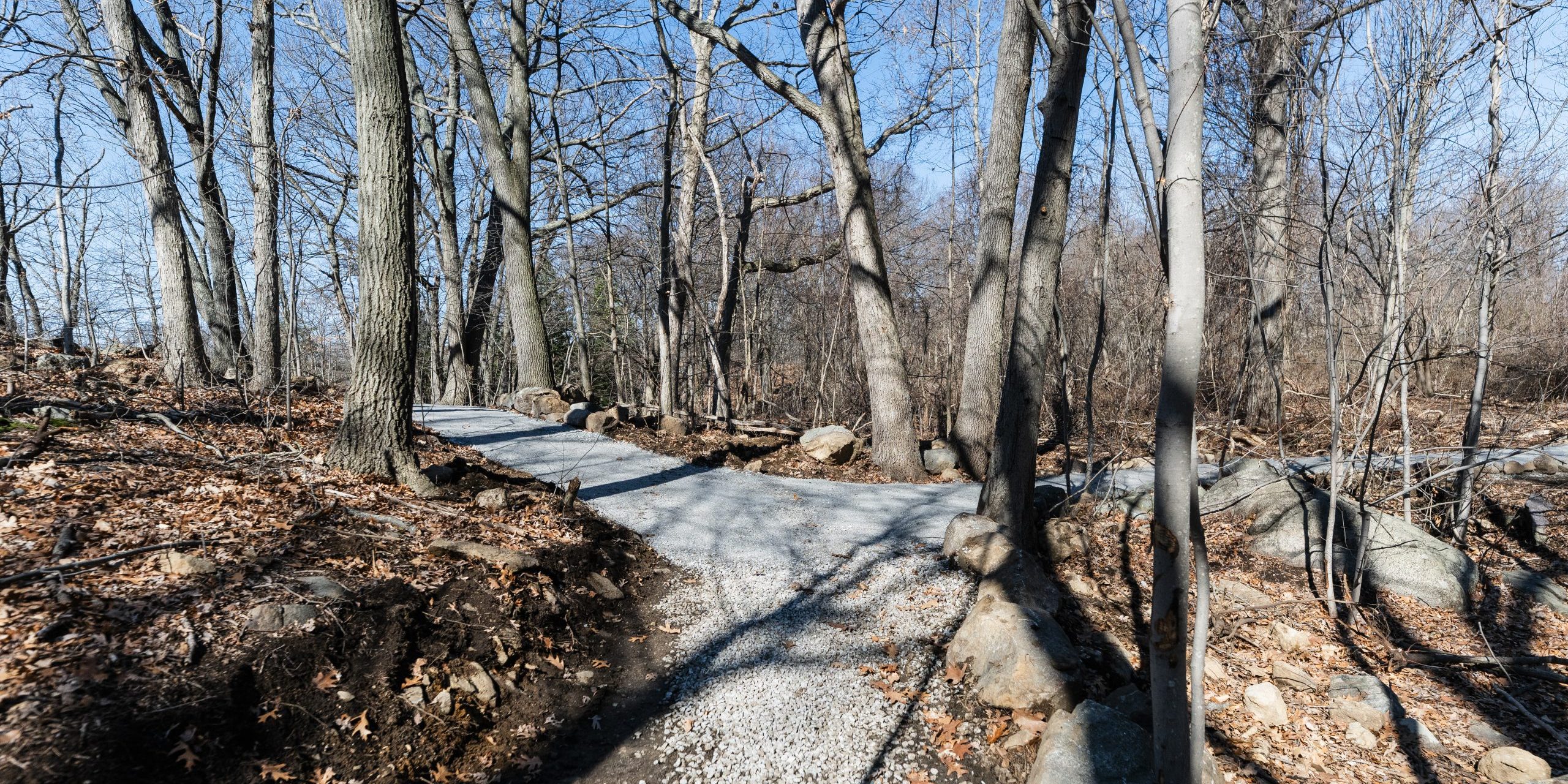
SWAMPSCOTT — The Conservation Commission met Wednesday night to discuss the Archer Trails project, focusing on a portion of the trail network that falls within a regulated wetlands buffer area.
The Commission’s discussion follows concerns made to the town by residents in the Archer Woods neighborhood, including Frank Smith, who sent a March email to the town administrator and Select Board formally demanding that the town “cease and desist all construction, development, and related activities associated with the Archer Trails project.”
Smith and other residents shared a range of concerns about the project, including the potential impact of construction work in a neighborhood that Smith said has a history of flooding and stormwater runoff concerns.
In a previous conversation with the Item, Smith said that the construction that began at the end of March was not aligned with what was communicated by the town. Town officials confirmed that construction was paused upon the residents’ concerns.
The Archer Trails project was referred back to the Conservation Commission based on concerns that the work area might fall under the purview of the Wetlands Protection Act, which requires special permitting for work being done within 100 feet of wetland areas.
Following the halt on construction, the town submitted a Request for Determination, a formal process used to determine the boundaries of wetlands and other protected resource areas around a work project.
Swampscott’s Director of Community and Economic Development Marzie Galazka attended the meeting, and projected a map of the Archer Trails project. Galazka and Commission members said one segment of the trail — a spur that comes within roughly 75 feet of a wetland — falls under the Commission’s jurisdiction. The rest of the trail, commission members said, does not.
Still, Smith, who attended the meeting and made public comment on the project, said that his concerns extend beyond a single portion of the trail, both in terms of environmental impact and the broader process behind the project. He questioned why conversations surrounding the wetlands had not happened earlier in the project, before construction began.
“It makes me question how closely projects like these in town on the larger scale are being looked at,” Smith said. “Oversight is a major issue here.”
Members of the Commission repeated that the scope of their oversight was limited to the work in the wetlands buffer zone. Smith also raised concerns about potential impacts to the wetland itself, alleging that construction activity may have altered protected areas.
“There is evidence of the contractor that has already completed the work … uprooting entire trees and backfilling them into the wetland,” he said.
Smith also suggested that the area in question could function as a vernal pool, a type of seasonal wetland that provides habitat for certain species, saying that he had observed fairy shrimp in the area and pointing to wildlife activity as a concern.
Commission member Toni Bandrowicz said site visits and a formal delineation conducted by a wetlands scientist did not support the conclusion that a wetland had been filled, and said she did not agree that the area meets criteria of a certified vernal pool.
“I have been to the site; it has not been backfilled into the wetland,” she said, adding that she would be willing to revisit the area alongside a wetland scientist or Smith himself.
Bandrowicz acknowledged that the wetlands had not been delineated early in the process, but said that the town acted immediately once concerns were raised.
“It was overlooked,” she said. “But the minute it was identified by you, we did everything we could to look at it and address it.”
Galazka said the project was initially treated as exempt under state regulations governing pedestrian pathways in conservation lands, but that they are now working to ensure the design meets that exemption compliance.
Under the Massachusetts Wetlands Protection Act, certain pedestrian pathways like the Archer Woods hiking trails can qualify for an exemption from permitting if they meet specific conditions. The exemption generally applies to narrow footpaths (no more than three feet wide) that are designed to minimize disturbance and do not significantly alter the surrounding wetlands area.
Commission members said the town is seeking to bring the project into compliance under that exemption by modifying the portion of the trail that falls within that wetland buffer zone.
Bandrowicz said the town had two options to meet compliance. The first would be ensuring that the pedestrian pathway width exemptions are met, and the second would be to shift that section of the trail further away from the wetland boundary if needed, which would push the trail out of the commission’s jurisdiction entirely.
At the same time, Bandrowicz said questions about whether any wetland impacts have already occurred could be investigated separately.
The discussion ended with Bandrowicz introducing a motion to issue a negative determination, with the understanding that the town will either comply with the width exemption or shift the trail. Her motion also included a provision to have the wetlands scientist revisit the area based on Smith’s claims that the wetlands had already been backfilled or disrupted.
If that review finds that the wetland was altered, the commission could take further action at a future meeting.
The Commission approved the motion unanimously, clearing a path for the town to move forward with a revised version of the project that complies with state wetlands regulations.
24World Media does not take any responsibility of the information you see on this page. The content this page contains is from independent third-party content provider. If you have any concerns regarding the content, please free to write us here: contact@24worldmedia.com

Greenport native Joey Owens packed what he could fit in the car and drove west. The 24-year-old...

The post Today’s page 1: 4-30-26 appeared first on Itemlive. Source...

LYNN — Lynn Public Schools are set to receive $19.4k, with funding aimed at strengthening partnerships,...

Swampscott’s boys tennis team secured a 3-2 victory in Salem Wednesday — theatrics included. Victor...
SWAMPSCOTT — The Conservation Commission met Wednesday night to discuss the Archer Trails project,...

All address information, particularly arrests, reflects police records. In the event of a perceived...

Saugus shows up strong for school funding

Lynn May Day Rally to mark 20 Years

Four more years for Peabody Super

LTTE: Opposition to Article 34 and landfill expansion urged

LTTE: Union backs override to prevent cuts

LTTE: Article 34: Opening the door to informed decisions in Saugus

Lynnfield has a tree-mendous year

Commentary: Demolition derby: The problem with the Kentucky Derby is Churchill Downs

Businesses and nonprofits kick in $2.2 million for seniors

Southold/Greenport girls track duo builds each other up

Athlete of the Week – Lynn Classical’s Brooke Braswell

New chef revamps Ram’s Head Inn menu with hyper-local, from-scratch focus