

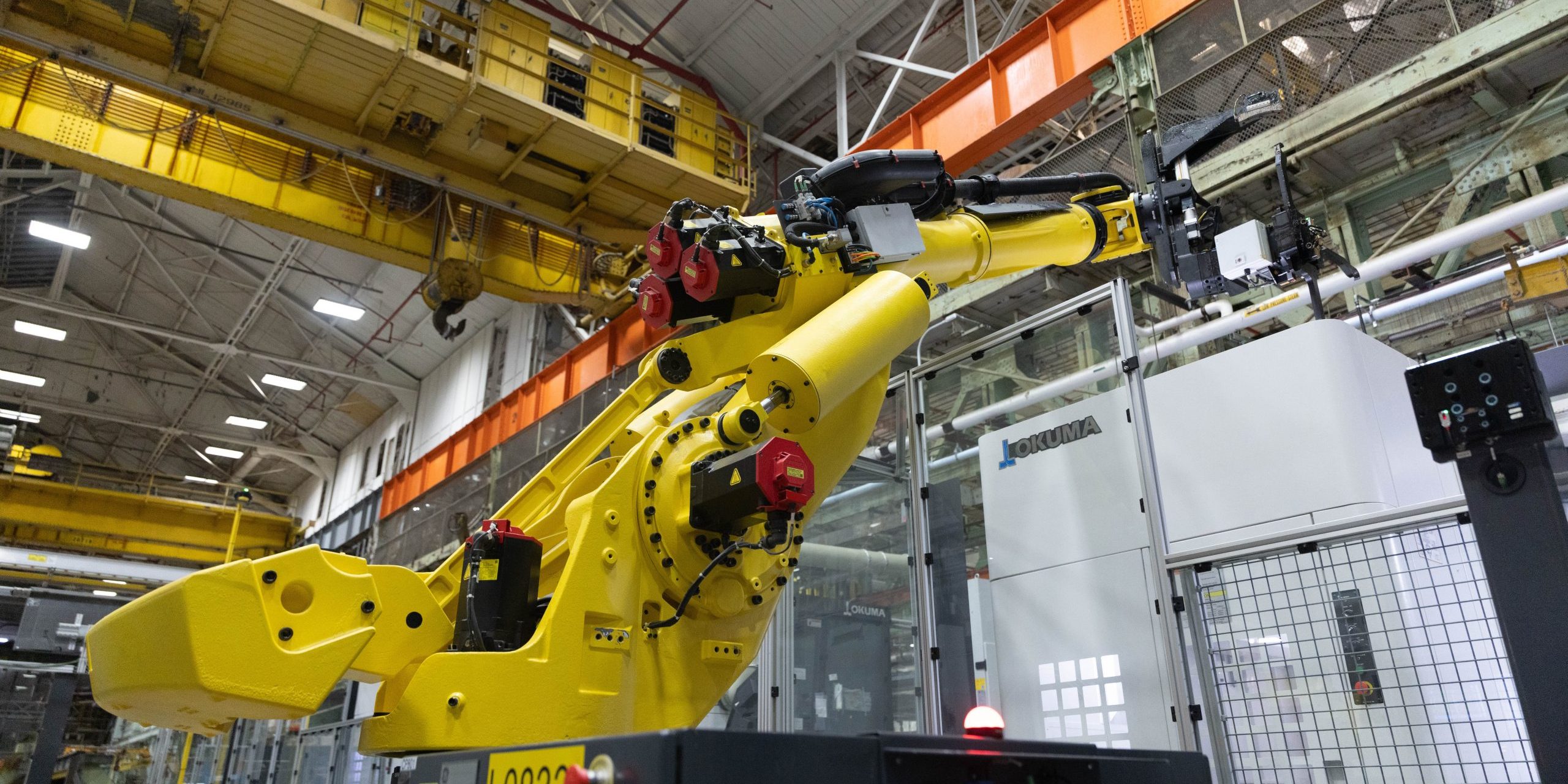
LYNN — Inside GE Aerospace’s sprawling Lynn manufacturing complex, robots named Rosie and Thomas move between machines, delivering tools and engine components through an automated system that would have looked out of place during most of the plant’s more-than-a-century-long history.
GE officials see systems like it as part of the future of the Lynn operation.
During a tour of the facility Monday, GE Aerospace showed how robotics, artificial intelligence, and 3D printing are changing the way the company designs and builds military engines at a time when defense customers are asking manufacturers to increase production and develop new technology faster.
Robotics
Daniel Martin, senior manufacturing engineering manager at GE Aerospace, said the case for robotics begins with keeping workers from having to perform repetitive or awkward tasks.
“It starts with ergonomics,” Martin said.
In one operation, he said, a robot can perform in roughly two minutes a task that previously took a worker about 30 minutes and involved manipulating heavy equipment.
The automated area has recorded a 47% reduction in injuries, he said.
But Martin said installing robots required GE to improve the manufacturing process itself first.
“You can’t automate something that produces weakness,” Martin said. “Otherwise, you just make defects faster.”
The result is a manufacturing cell where one operator can oversee six machines. GE has condensed work previously spread across 29 machines into a footprint of 12 while maintaining or increasing production capacity.
The system is also more complicated than the type of automation associated with an automotive assembly line.
Instead of producing the same component millions of times, GE’s system is designed to handle more than 50 different operations. The machines are largely interchangeable and can take different engine components depending on what work is waiting.
Parts ranging substantially in size can move through the same system, allowing GE to change the work being performed as engine demand shifts.
Martin said the flexibility is particularly important in aerospace, where production volumes are lower and manufacturers can be building components for several engine programs at once.
GE plans to automate another six machines over the next several years and is considering a second automated line using a different configuration, with robots suspended overhead rather than moving along the current track.
The existing system represented an investment of about $10 million, according to Vice President and General Manager of Defense Engines at GE Aerospace Defense and Systems, Paul Ferraro.
“It’s probably one of the largest automation systems in GE right now,” he said.
Ferraro acknowledged the pressure that comes with an investment of that size.
“When the company spends $10 million, they don’t have a lot of patience for us taking time getting the equipment running,” he said. “We have to show the ROI pretty much instantly.”
The company also rejects the idea that automation necessarily translates into fewer jobs at the plant.
Martin said increased productivity has instead helped the Lynn operation compete for work that could otherwise be performed at lower-cost locations elsewhere in the United States or overseas.
“We’ve actually been able to earn new work with automation,” he said.
GE is also using 3D printing to develop tools on the factory floor.
Instead of designing a tool, sending drawings to a machine shop, and waiting for a finished product, engineers can print a prototype, test it, and modify the design within hours, Ryan Wood, executive plant manager for aviation assembly and test operations, said.
During one recent project, an engineer produced six iterations of a tool in about five hours.
Artificial Intelligence
The physical transformation of manufacturing is increasingly being paired with artificial intelligence.
Jess Salzbrun, chief information officer for GE Aerospace’s Defense & Systems division, said AI has moved rapidly from an emerging technology to something being used throughout the company’s work.
“It’s very, very quickly become embedded into the daily work of our business,” Salzbrun said.
GE is applying it to engineering, manufacturing, supply chains, maintenance, and internal work performed by employees. The company is doubling its investment in AI, Salzbrun said.
“We have been very intentional at GE and within the Defense & Systems business to apply AI where it matters,” Salzbrun said.
Her description of GE’s approach was clear: “AI for us is really the amplifier, but our people are still very much the engine.”
GE has accumulated more than 100 years of engineering knowledge, including records detailing how engines and individual components were designed. Engineers can now use AI to search that body of information and quickly identify how GE solved similar design problems in the past.
If an engineer is designing a compressor blade, for example, the system can identify design practices and comparable blades from previous engines rather than requiring the engineer to manually search through decades of records.
AI can also conduct more design iterations, allowing engineers to weigh performance, durability, manufacturing requirements, and cost quickly.
Vice President of Engineering for GE Aerospace Defense and Systems, Darin DiTommaso, said that changes an old engineering tradeoff.
Rather than deciding between moving quickly, reducing cost, or conducting a more exhaustive design analysis, he said, AI allows engineers to pursue all three.
GE has already used the technology to revisit systems developed decades ago.
During one project involving software for technology originally designed in the early 1990s, engineers used AI to help ingest older engineering information, modernize software, and support testing. The work went from concept to validated software in about six months — 25% of the time GE said the process traditionally would have taken.
In another example, GE combined AI with simulation tools to work through potential preliminary designs for hypersonic propulsion. DiTommaso said a process involving mechanical, aerodynamic, and thermodynamic variables produced an optimized preliminary design “in a matter of seconds,” giving engineers a starting point for more detailed work.
AI is also being used to address a much less futuristic problem: finding out which part might prevent an engine from being delivered.
During the second quarter, GE conducted a 12-week AI effort focused on its F110 military engine program. Salzbrun said an F110 contains thousands of individual parts, meaning one missing component can hold up an engine even if everything else is ready.
Previously, employees could spend roughly half a day investigating a single parts constraint for one engine.
GE developed what Salzbrun described as a command center capable of pulling information from multiple sources and using AI to scan engine bills of material for potential problems.
The latest information about a component does not always live neatly inside one database. It can be buried in supplier communications, emails, or other unstructured data.
“Unless somebody was going and digging into every single piece of intelligence that we have and mapping that to every one of those thousand parts, that becomes really, really challenging,” Salzbrun said.
AI can instead surface the highest-risk parts, so employees know where to focus their attention.
Salzbrun said F110 output during the second quarter of 2026 increased by 50% compared with the same quarter in 2025. GE has since expanded the technology to the F404 program and is beginning to see production gains there as well.
The F110 example is part of GE’s broader Defense & Systems business rather than the Lynn assembly line itself, but it illustrates the production problem the company is attempting to solve across its military portfolio: building more engines without relying solely on more people, machines, and factory space.
AI is moving into maintenance as well.
GE is working with Palantir on its TrueChoice Defense digital logistics and sustainment platform, which analyzes engine data to help military customers predict maintenance needs and avoid unplanned engine removals.
A fleet manager can open the system in the morning and receive an automated briefing identifying engines or components requiring attention and recommended maintenance actions.
Salzbrun said GE is also deploying generative AI to more routine employee work, including summarizing meetings, analyzing data, conducting research, and creating documents.
The company is targeting a 10% productivity improvement and estimates AI could return more than 60,000 engineering hours to delivery schedules over the next year.
“This is not necessarily about doing less,” Salzbrun said. “It’s about freeing up our experts to spend their time doing what they are best at.”
The company is investing in a centralized data system and employee training while requiring human oversight of AI-generated recommendations.
“In a business like ours, lives and mission depend on the technology that we create and put into the hands of our customers,” Salzbrun said.
Defense Updates
The push to produce faster comes as GE expands its defense portfolio, including work on technologies that could shape the next generation of military aircraft and naval vessels.
During the presentation in Lynn, Steve “Doogie” Russell, vice president and general manager of GE Aerospace’s Edison Works, highlighted the XA102, GE’s adaptive-cycle engine developed for next-generation combat aircraft.
GE also announced that it was awarded a new Defense Innovation Unit contract to advance the development of a hypersonic test bed through the Hypersonic and High-Cadence Airborne Testing Capabilities program, known as HyCAT.
The contract moves the program into its next stage after work that began with initial funding in 2023.
Under the new phase, GE will design and develop a combined booster and cruiser system that together form what the company calls an “all-up-round” hypersonic test bed. The liquid-fueled platform is intended to provide a more flexible way to conduct hypersonic flight testing as the military works to develop weapons and propulsion systems capable of traveling at more than five times the speed of sound.
The project has advanced in stages. GE began concept development and team formation in 2023, moved into subsystem refinement and evaluation in 2024, and conducted a preliminary design review of the complete system in 2025.
The 2026 phase will focus on integrating the booster and cruiser into the full test vehicle and beginning qualification and component-level testing of key systems.
“Acceleration in this type of hypersonic testing is critical to advancing next-generation capabilities at speed and scale,” Russell said. “This work with DIU builds on years of investment and progress.”
Edison Works, GE Aerospace’s advanced defense development organization, has increasingly focused on rapid prototyping and digital engineering as the company competes to develop future military propulsion systems.
The hypersonics announcement was accompanied by another defense contract, this one at sea.
GE Aerospace will supply 12 LM2500+G4 marine gas turbine engines to power six KDDX next-generation destroyers for the Republic of Korea Navy.
The KDDX will be the first Korean Navy ship equipped with both stealth-integrated radar and a combination of anti-aircraft and land-attack missiles, according to GE.
The ships will also use full electric propulsion, with the LM2500+G4 turbines helping generate power for propulsion and increasingly electricity-intensive radar, weapons, and other ship systems.
Asha Belarski, vice president and general manager of GE Aerospace’s Marine Engines & Systems business, called the transition to full electric propulsion “a step toward the next generation of naval power.”
The engines will be supplied in collaboration with licensed manufacturers in South Korea.
GE Aerospace has an installed base of approximately 30,000 military aircraft engines worldwide, in addition to about 50,000 commercial engines, according to the company. The HyCAT and KDDX programs are part of GE’s broader defense portfolio and should not be confused with work performed specifically at the Lynn plant.
“The expectation from our military customers is incredibly clear,” Salzbrun said. “They need our products, they need our services, and they need them faster.”
The post Robots and AI reshape GE Aerospace in Lynn appeared first on Itemlive.
24World Media does not take any responsibility of the information you see on this page. The content this page contains is from independent third-party content provider. If you have any concerns regarding the content, please free to write us here: contact@24worldmedia.com
LYNN — Inside GE Aerospace’s sprawling Lynn manufacturing complex, robots named Rosie and Thomas move...

MARBLEHEAD — Marblehead firefighters quickly extinguished a fire that broke out in a barn on Pleasant...

Peconic Landing in Greenport hosted its annual music and fireworks celebration on Sunday as the summer...

I didn’t think two men riding bikes would make me think really hard about life. I was in Swampscott the...

NAHANT – The Council on Aging will host a free Medicare Workshop on Monday, Sept. 14, with Malden-based...

PEABODY — Running was something Chris Sakelakos and his wife, Christina, shared long before cancer...

Letter: Ask The Big E to cancel partisan exhibit

Police Logs: Aug. 30, 2026

Saugus board solves unusual zoning issue

Editorial: Sometimes the best classroom technology is none at all

CALL IT A CLASSIC
Letter: These midterm elections are a crucial moment for food access in our community

David “Mac” MacEwen: Support service members, long before they become veterans at risk of incarceration

Swampscott seeks to improve parking enforcement

From Lynn Tech to Cornell, Awan is making waves

St. John’s Prep off to quick start

Lynnfield’s Antidormi hopes to fly with Falcons

Artists invited to transform Peabody street