


Taking things for granted absolves us of the need to look under the hood to see why the car continues to start every time we hit the ignition. Applied to the safety net that ensures the well-being of the population, we have come to take for granted one of the hallmarks of our republic from its inception. The United States Public Health Service is a collection of agencies within the federal government that seek to manage the public health of our nation. Today, it comes under the jurisdiction of the Secretary of Health and Human Services. It is the latest incarnation of the Act for the Relief of Sick and Disabled Seamen, authorized by Congress during the presidency of John Adams in 1798.
Since the late 18th century, our nation has recognized the importance of supporting the health of all our citizens. Through many reorganizations and the establishment of the role of surgeon general, the present Public Health Service carries forward the insight of our Founding Fathers that our nation can only be strong if our citizens are healthy. During this 250th anniversary of the signing of our Declaration of Independence, this insight is worth revisiting as the concept of globalization amplifies the wisdom of our forebears.
Concern about the health of our citizenry and all our residents is one dimension of the common good. This concept has deep political roots that go back to Aristotle, Thomas Aquinas, and John Locke. In our own day, it is a hallmark of what has come to be known as Catholic Social Teaching. Though also addressed in other religious traditions, it has an importance that transcends religious differences and a resonance within the platforms of all political persuasions in a liberal democracy.
The former mayor of Lynn, Chip Clancy, would end every speech he gave by wishing everyone “good health”. He knew that good health was and is foundational for everything else in life. In addition to being a personal thing, good health is an aspiration of everyone on the planet. COVID-19 reminded us that we are all connected to one another because a virus from thousands of miles away caused havoc around the world. This pandemic elevated globalization from an economic theory into a public health reality. It taught us that public health is no longer a national concern but an international worry.
Ebola in Africa is a lethal epidemic that has already brought death to over one hundred people. So far, it is contained in the Democratic Republic of Congo and Uganda. Should it break out from there, it could bring death and devastation worldwide. Viruses do not care about national borders, and nativist rhetoric, rooted in xenophobia, does not prevent their transmission. The only real antidote is a renewed understanding and expansion of the common good that excludes no person, no country, and no group of people, regardless of differences.
The World Health Organization (WHO) was established in 1948 as the first specialized agency of the United Nations. Since then, it has had a proud history of targeting malaria, tuberculosis, syphilis, and leprosy. The United States Agency for International Development (USAID) was established by President John F. Kennedy in 1961 as a way of assisting developing countries around the globe with technical assistance in food production, public health, and education. It took great leadership in the elimination of smallpox worldwide. These organizations epitomize the growing awareness that the common good needs to be defined more broadly than an agenda or mentality that focuses exclusively on one nation’s health and well-being. Under the current leadership of the United States, however, USAID no longer exists, and our country has withdrawn from membership in the WHO.
Public opinion in a democracy should drive public policy. Presumably, public opinion in the United States does not support US membership in the WHO or the mission of USAID. This makes great sense if the common good is defined narrowly. If history is any kind of teacher, however, it should help us to see that the narrow definition of the common good is not only short-sighted but lethally dangerous for one’s own country and the rest of the world.
Msgr. Garrity is the former pastor of St. Mary’s Parish and School in Lynn and a Senior Priest of the Archdiocese of Boston.
24World Media does not take any responsibility of the information you see on this page. The content this page contains is from independent third-party content provider. If you have any concerns regarding the content, please free to write us here: contact@24worldmedia.com
Taking things for granted absolves us of the need to look under the hood to see why the car continues to...
PEABODY — State Rep. Thomas P. Walsh (D-Peabody) announced that the Higgins Middle School’s Student...
PEABODY — Following a steady increase in antisemitism and hate speech at Higgins Middle School,...

LYNN — The bikes are back in town. After a quarter-century absence, the Lynn Police Department...
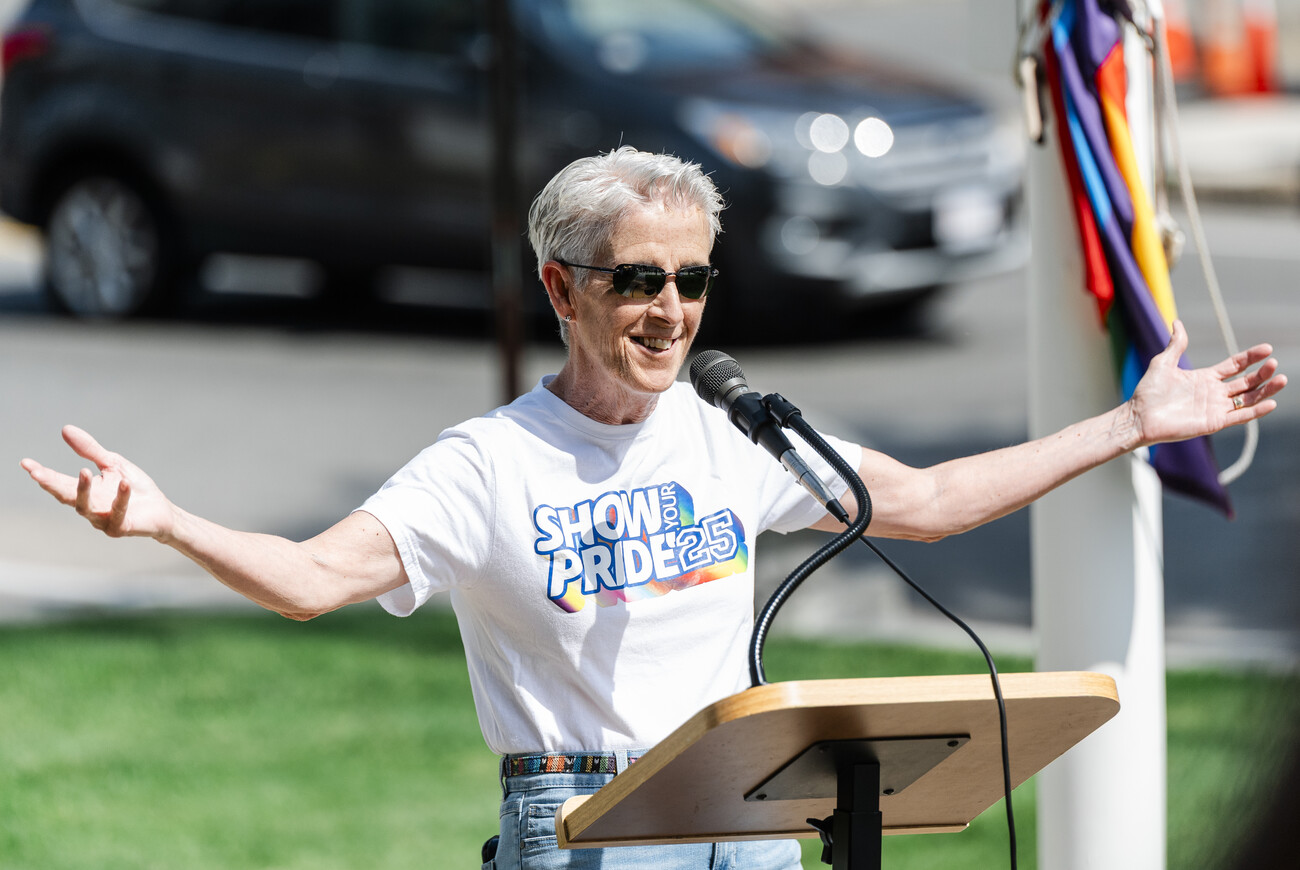
PEABODY — Queer people and many allies of the LGBTQ+ community joined together Wednesday morning...

To the editor: Today was an inspiring day. I had the privilege of serving as an election worker and...
Schedule: 2026 Agganis All-Star Games

Car vandalizes Marblehead’s Piper Field
Cutchogue firefighters serve up breakfast for a good cause
Suffolk Times writer Michael Lewis chronicles 40 years of World Cup coverage in new book
Carrigan endorses Koh for Congress
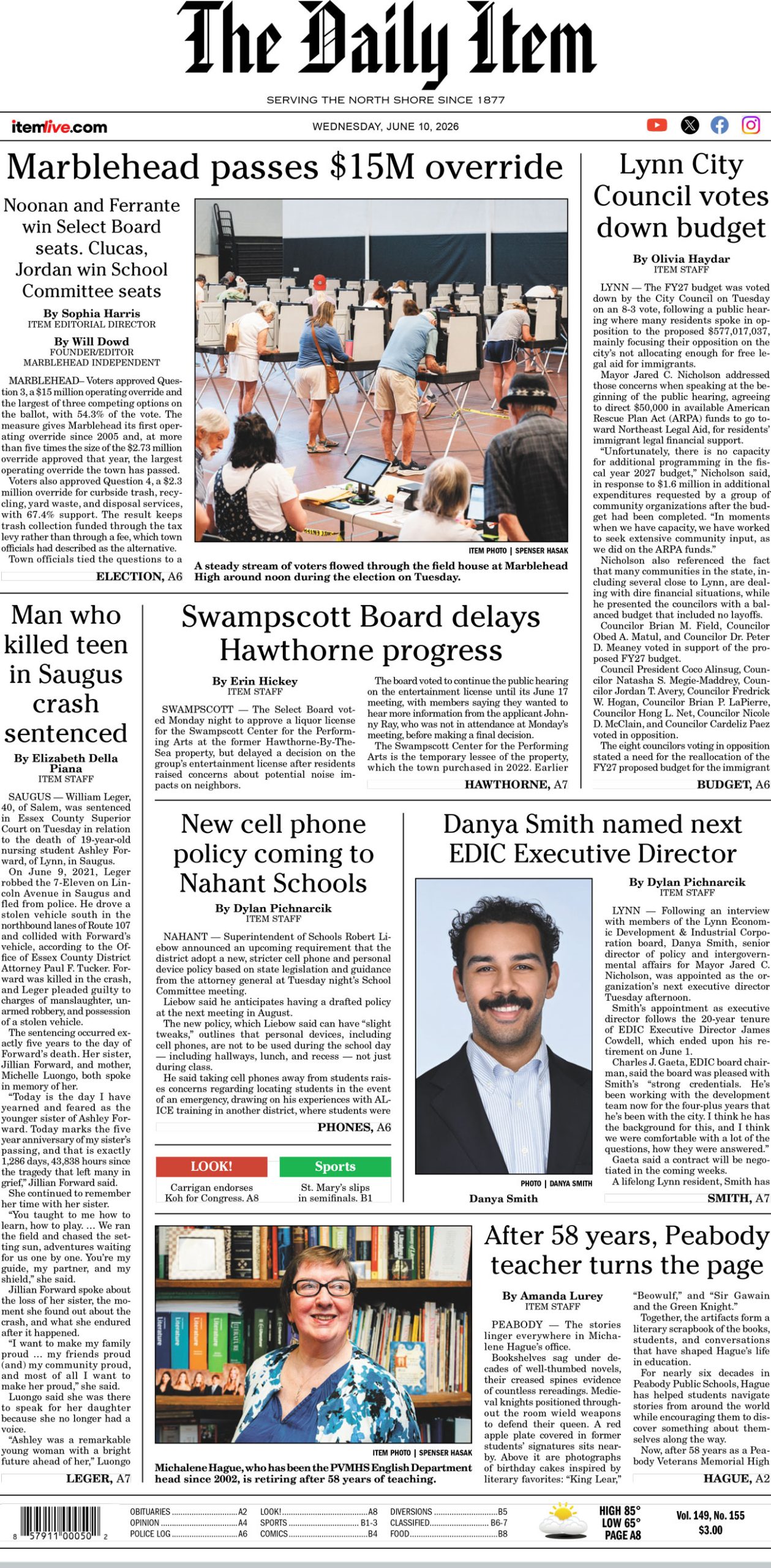
Today’s page 1: 6-10-26
Lynn City Council votes down budget
Marblehead passes $15M override – Itemlive
New cell phone policy coming to Nahant Schools

State tournament roundup: St. John’s Prep laxmen bounced in battle of the birds

St. Mary’s slips in semifinals

Swampscott talks plans for affordable housing