

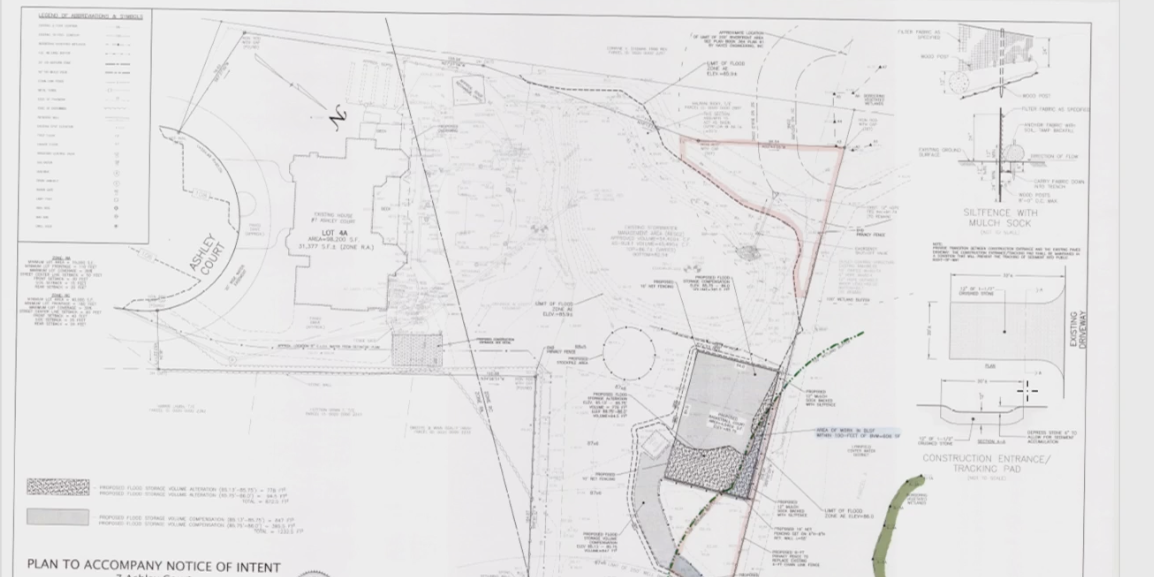
LYNNFIELD – The Conservation Commission met to continue the discussion on 7 Ashley Court and its proposed basketball court in the applicants backyard where the main struggle has been over the disturbance of the wetlands in the area.
This has been an ongoing issue since the Conservation Commission’s May meeting. Chris Sparages, co-owner of the North Shore engineering company William and Sparages, discussed the lingering worries that the construction may cause too much distribution to the natural environment.
At the commission’s August meeting, Rich William, of William and Sparages, scheduled a site visit with the commissioners to ensure there was a clear understanding of the construction space.
“During the site visit, we were able to show the limit of work and the tree clearing that we’re proposing,” Sparages said. “Obviously, several trees will need to come down in order to complete the construction of the basketball court, but we did note that the applicant is committed to only taking the trees that are necessary to accomplish the work shown in the plan.”
Within the Notice of Intent application, William and Sparages, along with the applicants Daniel and Melanie Lewis, agreed to conduct invasive species plant management which would include removing any if necessary and reseeding any disturbed areas.
“That was proposed to offer mitigation toward the removal of trees on the project,” Sparages said.
On the site plan itself, Sparages explained to the commission how they are planning to work with the issue of bordering land subject to flooding. The wetland area that has been mentioned as an issue as it relates to the basketball court construction has a buffer zone of 100 feet.
William and Sparages have been working in tandem with the Lynnfield Center Water District to flag any wetlands surrounding the construction area to ensure they are flagged before construction starts.
“But with the discussion of trees,” Sparages said. “We have these jurisdictional areas, 100-foot buffer zone from those two bordering vegetative wetlands, and we have the limit of the bordering land subject to flooding.”
Sparages further explained that the applicant agreed not to do work within the area closest to the wetlands’ 100-foot buffer zone to not only protect this area but to eliminate any unnecessary work in the area. Instead, the applicant agreed to do invasive species management in this area.
The commission’s response was frustration. In their eyes, there were certain agreements made back in May that had been skipped over by the company. One of these agreements was to contact the Home Owners Association for the neighborhood. The company was asked to provide a sign-off by the HOA on whether the reduction of trees that provide shade in the area is acceptable.
Because this was not provided for the September meeting, the commissioners felt they could not further the discussion with Sparages.
“The way I see it,” Commission Chair Donald Gentile said, “there’s two options. Either you’re interested in coming back and getting written certification from the homeowners association that they know what you’re proposing and provide information regarding how you would mitigate the removal of trees. If you don’t, you could ask us to take a vote tonight, and we’ll probably deny it for lack of information.”
In response, Daniel Lewis spoke to the commissioners with a shared frustration on the delays after a significant amount of time and work had been done.
“Is it reasonable to ask what you want and that way I know if it’s something that I feel I can do,” Lewis said. “I would prefer to work with you, but I don’t want to do a bunch of work and come back if you guys are dead-set against this project. I’d rather just know now and move on.”
The commissioners made it clear they were not trying to be difficult, but they felt there were responsibilities on the commission’s part, such as the need for an HOA certification, that were not being treated as important.
“Our goal is not to drag this out,” Commission Vice Chair Kirk Mansfield said. “But the number one thing we hear from everybody in this town is that everybody’s clear-cutting these lots, and the town is losing all of its character. That was a big reason why the tree bylaw was passed. We do have an obligation here.”
While there was no vote on this project plan, both the commission and the applicants came to the agreement that a clear cut mitigation plan will be created for October’s meeting, where the hope is a more concrete decision will be decided and the possibility for a vote.
The post Lynnfield continues discussion on Ashley Court appeared first on Itemlive.
24World Media does not take any responsibility of the information you see on this page. The content this page contains is from independent third-party content provider. If you have any concerns regarding the content, please free to write us here: contact@24worldmedia.com
LYNNFIELD – The Conservation Commission met to continue the discussion on 7 Ashley Court and its...

MELROSE — Two quick strikes late in the second half turned what looked to be a disappointing defeat...

Let me start by saying this: I have nothing against Pat McAfee. I’m sure he’s a nice guy and, heck,...

One of the wonderful fringe benefits of following sports is that you get to act like an imbecile without...

LYNN — The Swampscott football team (2-0) stormed onto Manning Field and walked away with a 28-8...

No home field, no problem for Lynn Tech’s football team (1-1), which took down Montachusett Tech, 39-0,...

DEI page 1: 9-29-26

Late heroics seal St. Mary’s comeback

Porters boys’ golf defeats Tuckers for first time in over a decade

David M. Shribman: A posthumous critique for liberals
City honors Civil Rights leader Abner Darby

Peabody business prioritizes patriotism
GLSS’ Rainbow Alliance to host book talk with Lynn author Jim Moser

Letter: I’m concerned about unanswered questions on Glover development

Square One Mall in Saugus faces foreclosure
Swampscott goes out on a limb for trees

Gregg House breaks ground for new facility

Resident at Greenport complex recalls frantic fire scene: ‘controlled chaos’