

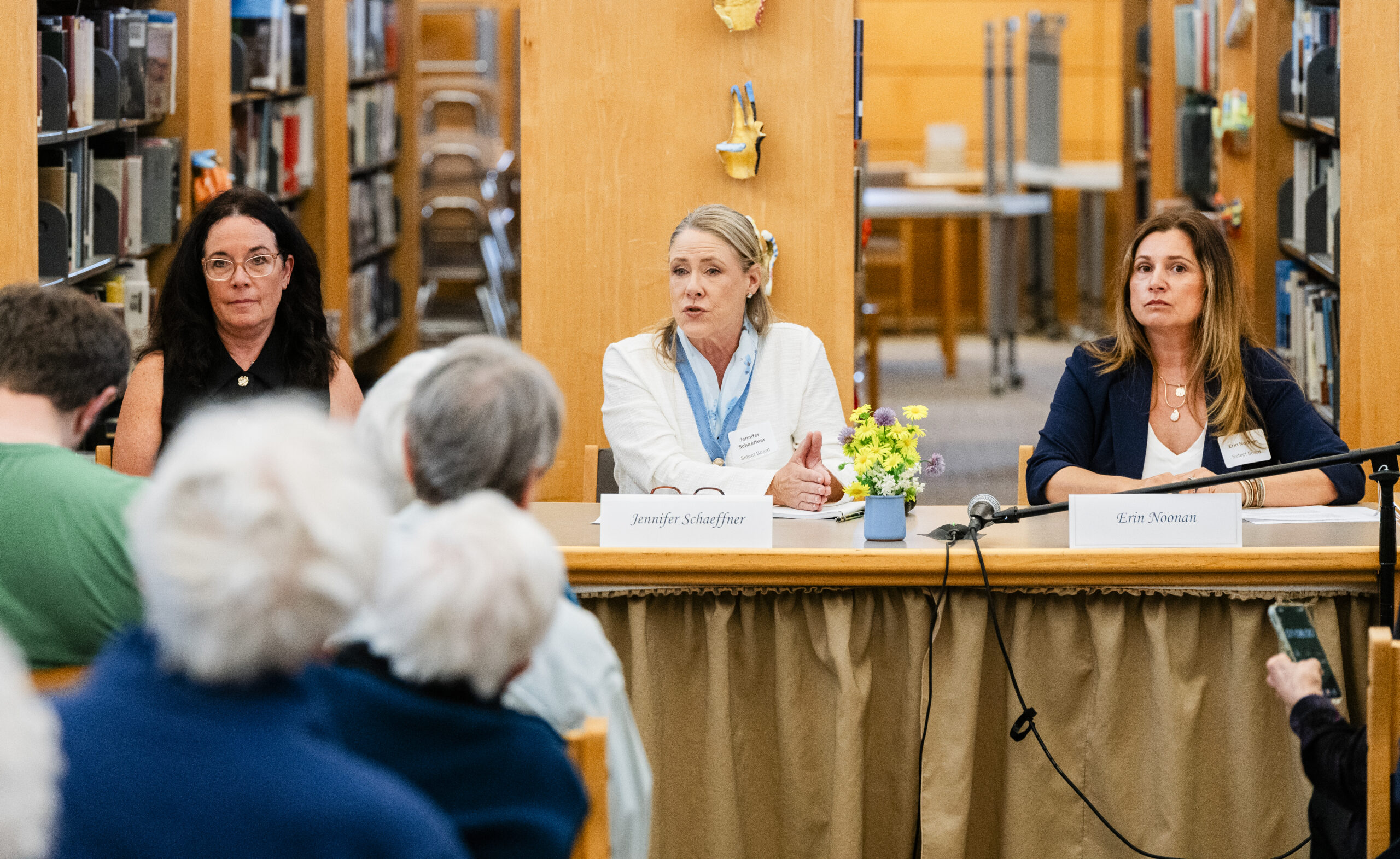
MARBLEHEAD — With Marblehead facing one of the most consequential elections in recent memory — including a multiyear override proposal and growing concerns over the town’s fiscal future — candidates across nearly every contested race used Tuesday night’s League of Women Voters forum to state not only why they should be elected, but what kind of leadership the town needs during a period of uncertainty.
Voters will choose between candidates in races for two Select Board seats, two School Committee seats, Town Moderator, Housing Authority, Recreation and Parks Commission, and Cemetery Commission when they head to the polls on June 9.
The conversations repeatedly returned to themes of transparency, long-term planning, accountability, and whether town government has become too fractured.
In the closely watched three-candidate race for two Select Board seats, incumbent Erin Noonan defended the proposed override package and framed the election as a referendum on the town’s financial direction.
“This role requires making tough decisions in Marblehead’s long-term best interest, even when they are controversial,” Noonan said, citing issues including the MBTA Communities Act, meals taxes, and the town’s Community Development and Planning Department.
Noonan strongly supported the town’s tiered override proposal and warned residents that service reductions would be severe if it failed. She also said she supported a tier three override.
“This will impact people on the spectrum economically differently,” she said. “There, make no bones about it, that this, these cuts this year are real. This, if this override does not pass, we will have a 12% workforce reduction.”
Candidate Rossana Ferrante said she supported the second override tier because it would stabilize finances while giving the town time to pursue alternatives to relying heavily on taxpayers.
“There’s no question that we need an override,” Ferrante said. “Tier two is the most logical because it allows us to stabilize, and then we can take some time to figure out what else we can do.”
Ferrante also argued that divisions within town government have worsened because residents feel ignored.
“People don’t feel heard, and so when people don’t feel heard, people get louder,” she said.
Candidate Jennifer Schaffner repeatedly emphasized fiscal discipline and management experience, arguing that town government must focus on maximizing existing resources before asking more of taxpayers.
“Marblehead is facing real fiscal challenges, and what we need is not just more revenue, but leadership that knows how to use the resources we already have with greater discipline and accountability,” Schaffner said.
Schaffner later said the compromise surrounding the town’s MBTA Communities Act debate offered a model for how Marblehead could move forward politically.
“What finally happened is when the two tides came together,” she said. “Maybe not everybody loves it, but that’s typical, and it’s a successful compromise.”
Transparency and accountability repeatedly surfaced throughout the Select Board discussion, particularly surrounding the memorandum of understanding signed by the Select Board, School Committee, and Finance Committee tied to the override proposal.
All three candidates said they supported the agreement.
“I was a part of the creation and development of the MOU,” Noonan said. “It’s a measure of accountability.”
Schaffner said the previous agreement between the boards “wasn’t followed,” adding, “Had it been, there might have been some things that would have been different.”
Ferrante called quarterly financial reviews “super critical” and said the town needs “the right leadership” overseeing those discussions.
Fiscal concerns also dominated discussion in the three-candidate race for two School Committee seats, where candidates debated declining enrollment, special education costs, and transparency in the budgeting process.
Former Committee member Sarah Fox criticized how this year’s budget discussions were handled.
“One of my biggest hurdles that I’ve seen this year is sitting at the budget hearing … and knowing that there were members at this table that presented a budget for discussion at a budget hearing that they knew they’d already agreed to cut an additional 1.5 million from,” Fox said. “That’s not transparency.”
Fox also pushed for zero-based budgeting and corrected fellow candidate Melissa Clucas during one exchange about the legal authority of the School Committee over budgeting decisions.
“So, I have the experience to know what the Ed Reform Act is, and what our legal guidelines are,” Fox said. “By state statute, it is the sole authority of the School Committee to direct what happens with our budget.”
Fox argued that changing enrollment patterns require a rethinking of school spending.
“Our enrollment has changed so drastically, and the makeup of the students that are currently in our schools does not look like the makeup of 10, 20 years ago,” she said.
Clucas defended the Committee’s recent work, particularly around communication and collaboration between town boards.
“For the first time, the School Committee, the Select Board, and the Finance Committee worked together, not in silos,” Clucas said.
Clucas described transparency less as a slogan and more as a communication challenge.
“Public meetings can become a bit performative,” she said. “A lot of words can be said to accomplish something that’s very basic in terms of transparency and concepts.”
During her closing statement, Clucas also urged residents to support both her candidacy and fellow candidate Ann Marie Jordan, highlighting an emerging alignment between the two campaigns.
“I want Marblehead schools to be something this whole community can be proud of, and we’re not done yet. Vote Clucas and Jordan on June 9,” she said.
Jordan, a former educator and administrator, said the district’s long-term challenges would require both advocacy and strategic planning.
“If you read any Boston Globe article, you understand that all school districts in the state of Massachusetts are experiencing these types of enrollment declines,” Jordan said.
Jordan also argued that transparency depends on direct and honest communication.
“The best way to ensure transparency is to speak clearly and to speak truthfully,” she said.
The Town Moderator race between incumbent Jack Attridge and challenger Peter Jaffe focused largely on procedure, public conduct, and preserving confidence in Town Meeting.
Attridge, seeking another term, described Town Meeting as both a professional responsibility and a personal passion.
“Town meetings are sort of my Netflix and my hobby,” Attridge said.
Jaffe praised Attridge’s experience but argued that the role requires stronger enforcement of decorum during contentious debates.
“I feel one thing that hurt us in the last town meeting, and I would like to see consistency in simple things like, do we raise our hands or we press a button. I feel town meetings should have everyone in place, understanding there is a rule, and just be consistent throughout it,” he said.
Attridge said, “We have our own traditions that we’ve undertaken over the years, and we’ve taken on some new ones, electronic devices, voting devices, which was one of them, and we learn along the way.”
He added, “Chapter 39 Section 15, moderators roles is that the moderator should preside over and regulate the proceedings of Town Meeting. I think I’ve done the best job that I can to meet that goal.”
The six-candidate race for five Recreation and Parks Commission seats featured extensive debate over artificial turf at Reynolds Field, one of the town’s most contentious recreational issues. In the running are incumbents Larry Simpson, Chris Kennedy, Karin Ernst, and Shelly Curran Bedrossian. The challengers are Kenneth Klaiman and Michael McCarthy.
Incumbent Simpson, who opposed the turf proposal, cited health and environmental concerns.
“There are tons of microplastics, there’s PFAs in artificial turf, it heats up a lot,” Simpson said. “I went on record as the only person who voted against the artificial turf, or at least a pause on it.”
Incumbent Kennedy defended the project, arguing that the town lacks sufficient playable field space.
“We need more playability in town. We need more turf,” Kennedy said.
Challenger Klaiman offered a simpler position.
“Real grass and no chemicals,” Klaiman said. “There’s no better experience than playing in the rain, in the mud, getting covered in grass.”
Incumbents Ernst and Bedrossian both stated that the decision to move to artificial turf was an extensive and deliberate process that was hard to explain in under a minute.
Bedrossian said, “We went, and we looked at the economics, the replacement values, market demand, what the youth sports actually want, and they were a big part of our decision as well, or at least my decision – listening to them.”
Ernst agreed, adding, “It’s a balancing act; we went back and forth between what is out there for studies on artificial turf, which is getting better and better. Is it perfect? No, but it does allow for more playability, and you know that’s another part that we just don’t want to forget. We have a very short season.”
She said, “If it rains, we close everything down. No more playing in the mud, it’s not happening.”
Challenger Michael McCarthy did not attend the forum, but a statement was read on his behalf.
“Due to an unforeseen medical situation, I am unable to attend this evening. This is important to me, and I am disappointed,” he said.
He said he has more than 20 years of experience in commercial real estate, brokerage, underwriting, negotiating, managing properties, and property budgets. He also coaches Marblehead youth soccer, baseball, and football.
His statement read in part, “I believe I am the only candidate with children utilizing the fields today. Over the many years, I’ve played or coached on every field in town, and have been part of about every recreational program the town has to offer. I have worked for years with Rec and Parks as the general manager and historian of the Marblehead Softball league.”
Meanwhile, the Housing Authority race for one seat featured discussion about redevelopment opportunities and expanding housing options.
Challenger Jeffrey Weeden pointed to his professional background with the Lynn Housing Authority as a reason he could bring relevant experience to Marblehead.
He said he was born and raised in Lynn and has lived in Marblehead for about 14 years. Since moving to town and raising his son, who is active in the lower school community and youth sports, Weeden said he has been looking for ways to become more involved locally.
“I think Marblehead is at a really good point where a lot of these sites can be redeveloped,” Weeden said.
Weeden pointed specifically to mixed-income redevelopment possibilities and praised conceptual discussions surrounding the former Gerry School site.
“I think there are some good options, and I think that’s another opportunity where you can be proud of seeing some real change,” he said.
Incumbent Jean Eldridge did not attend the forum, but a statement was read on her behalf.
Eldridge said she has served on the authority for several terms and has “a practical understanding of how it works, institutional knowledge, and commitment to the residents we serve.” She said she has “no particular agenda,” but would work to ensure residents are “treated with dignity and respect.”
When Weeden was asked how he would respond to tenants who have historically felt unheard, he said his experience with a smoke-free housing policy taught him the importance of meeting directly with residents before decisions are made.
He said surveys, meetings, and one-on-one conversations helped reveal that more residents supported the change than he initially expected. “Meeting with the people one-on-one, getting their feedback ahead of time, and making sure they’re heard through the board meetings, I think, is a valuable thing to do,” he said.
In the two-candidate race for one Cemetery Commission seat, candidates discussed historic preservation, accessibility, and public engagement surrounding the town’s burial grounds.
Incumbent appointee Sally Sands said one of the commission’s biggest problems is a lack of public participation.
“I feel like the Cemetery Commission is sort of an island unto itself,” Sands said. “I would like to see us work to invite people into the cemetery meetings.”
Candidate Rose Wheeler McCarthy focused more on accessibility and maintenance concerns at Waterside Cemetery.
“The place is locked up like a drug store,” McCarthy said while discussing access to cemetery facilities.
Marblehead voters will head to the polls on June 9.
24World Media does not take any responsibility of the information you see on this page. The content this page contains is from independent third-party content provider. If you have any concerns regarding the content, please free to write us here: contact@24worldmedia.com
MARBLEHEAD — With Marblehead facing one of the most consequential elections in recent memory —...

MARBLEHEAD — Immigration attorney Diann Baylis announced that she has qualified for the Sept. 1...

All address information, particularly arrests, reflects police records. In the event of a perceived...
PEABODY – A Peabody man pleaded guilty to fraudulently obtaining more than $100,000 in coronavirus...

LYNN — St. Mary’s High School was selected by the Massachusetts Department of Environmental...

To the editor: I would like to provide additional context regarding a recent Daily Item article that...

Three dogs saved in two-alarm fire in Peabody

Survey says: Swampscott shows interest in community center

Ferry good news for MBTA commuters

Southold pastor Peter Kelley to retire after 27 years, deliver final sermon Sunday

Greenport weighs $25K ‘gift’ to upgrade Third Street basketball courts
Today’s page 1: 5-27-26

Lynn Rotary Club awards $6,000 in scholarships

State tournament roundup: Upset alert (x2)

Lynn schools ‘all the home team’ during city meet

Nahant Committee amends school seclusion policy

Mattituck track Malkush star breaks school record in 400 meters
Peabody Schools finalizes FY27 budget