

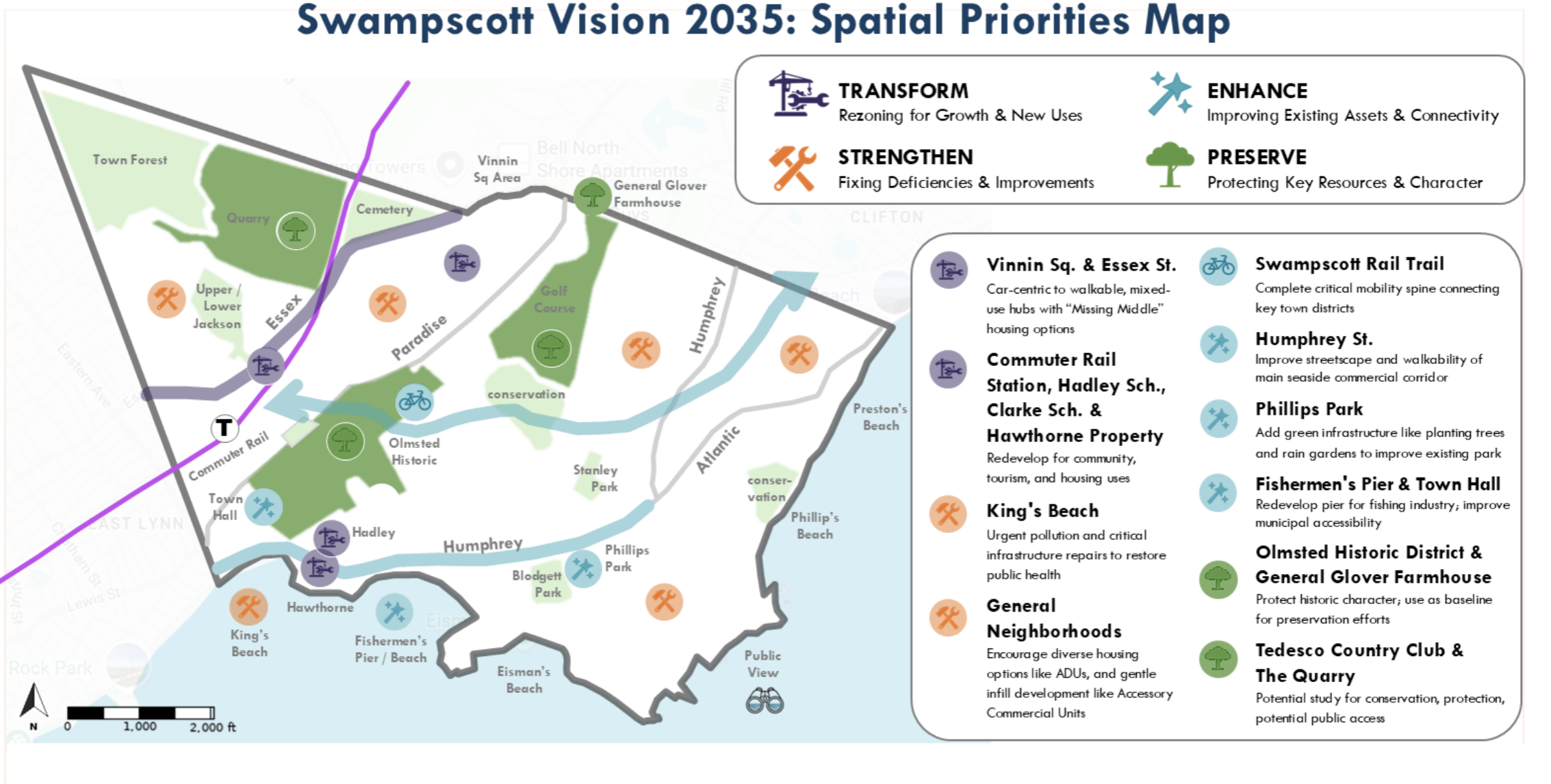
SWAMPSCOTT — The 2035 Master Plan, a document that will help guide Swampscott’s policy decisions over the next decade, is now open for its final round of public input, with town officials encouraging residents to weigh in before the plan is finalized.
The town released Draft 1.5 of the Master Plan earlier this month, beginning a public comment period that runs through April 1. The plan is expected to go before the Planning Board for adoption later this spring.
“It’s still in development,” said Director of Community and Economic Development Marzie Galazka. “It has not been adopted because we’re waiting for some more feedback,” she said, referencing that after the public comment period ends, the draft will go through the town’s Select Board and Planning Board.
The Master Plan serves as a long-term roadmap for town leaders, outlining how Swampscott policies could approach targeted issues like housing, transportation, economic development, and climate resilience through 2035. The draft document currently includes 42 goals, 96 strategies, and 247 recommended actions that are intended to guide those future policy decisions, investments, and zoning changes.
The draft is the result of an 18-month planning process that combined analytical data collection with extensive community engagement. According to the plan, input has thus far been gathered through 385 survey responses, more than 1,800 written comments, and three public forums with over 100 participants in attendance.
That outreach helped shape both broad priorities and more specific recommendations.
“We have a very active committee and want to make sure that we incorporate any changes coming from the public as well,” Galazka said.
Among the most consistent themes identified were the need to expand housing options, improve transportation, and address climate-related risks facing the coastal community — priorities that Galazka said were echoed repeatedly in community feedback.
“Residents have shared priorities around maintaining community character, improving traffic and pedestrian safety, expanding open space, and supporting thoughtful redevelopment,” she said.
Housing is a central focus of the plan, which notes that rising home values and limited housing diversity have made it difficult for many residents to find options that meet their needs. The document points to zoning constraints that have historically limited the development of smaller multifamily buildings, accessory dwelling units, and mixed-use housing.
To address those challenges, the plan recommends encouraging the development of diverse housing types on currently unused or vacant lots, including smaller multi-family buildings, while also preserving existing affordable housing options.
Transportation is another major priority, particularly as residents continue to raise concerns about town infrastructure. The plan identifies traffic safety, inadequate sidewalks, and limited bicycle facilities as ongoing issues and calls for improvements that support walking, biking, and access to transit.
Among the recommended strategies are expanding pedestrian and bicycle accessibility and advancing projects such as the long-awaited Swampscott Rail Trail improvement to create safer and more connected routes around town.
Climate resilience is also woven throughout the document, which makes reference to both the town’s unique coastal setting and its vulnerability as a seaside community. The plan highlights risks from sea level rise, flooding, and more frequent severe storms, and calls for investments in infrastructure such as seawalls, stormwater systems, and other protective measures.
The Master Plan isn’t an enforcing document, but it does serve as a guide for future town policy. “The Master Plan can be viewed as a roadmap for guiding land use, public investment and municipal decision-making,” Galazka said, noting that it can influence near-term decisions on zoning, capital projects, housing initiatives and infrastructure improvements.
While the plan lays out long-term priorities, it also organizes recommendations into short-, mid-, and long-term timelines, with 34 strategies identified as high priority in the first three years. These include improvements to transportation safety, housing production, and infrastructure needs.
The draft Master Plan is available on the town’s website, where residents can review the full document and submit comments before the April 1 deadline. Additional revisions are expected following the comment period, with a final version anticipated later this spring.
24World Media does not take any responsibility of the information you see on this page. The content this page contains is from independent third-party content provider. If you have any concerns regarding the content, please free to write us here: contact@24worldmedia.com
SWAMPSCOTT — The 2035 Master Plan, a document that will help guide Swampscott’s policy decisions over...

As the U.S. wades even deeper into the conflict with Iran, some Democratic and progressive political...

LYNN— The Boys &Girls Club of Lynn named Danielys Delgado its 2026 Youth of the Year. Delgado, 17,...

PEABODY– The 2026 Bridgewell Imagine the Possibilities online auction, featuring local excursions,...

PEABODY — Breaking Grounds Café on Main Street will be changing its hours, most notably by not being...

Two out of three isn’t bad, but three out of four would certainly be better. A seasoned and...

Fire scorches Linden Street home

Lynn’s Bella Owumi named Gatorade Player of the Year in New Hampshire

Burns named Marblehead volleyball coach

Lynn wrestling co-op rebounds after pandemic setback
Southold to hold hearings on BESS moratorium extension, ADU code changes
Today’s page 1: 3-18-26

Seventh-grader wins spelling bee fourth year in a row

Nahant board debates shed location
LHAND hosts annual St. Patrick’s Day Luncheon
Peabody school calendar approved – Itemlive

Police Logs 3/16/2026 – Itemlive

Saugus man sentenced to 19 years for drug trafficking