

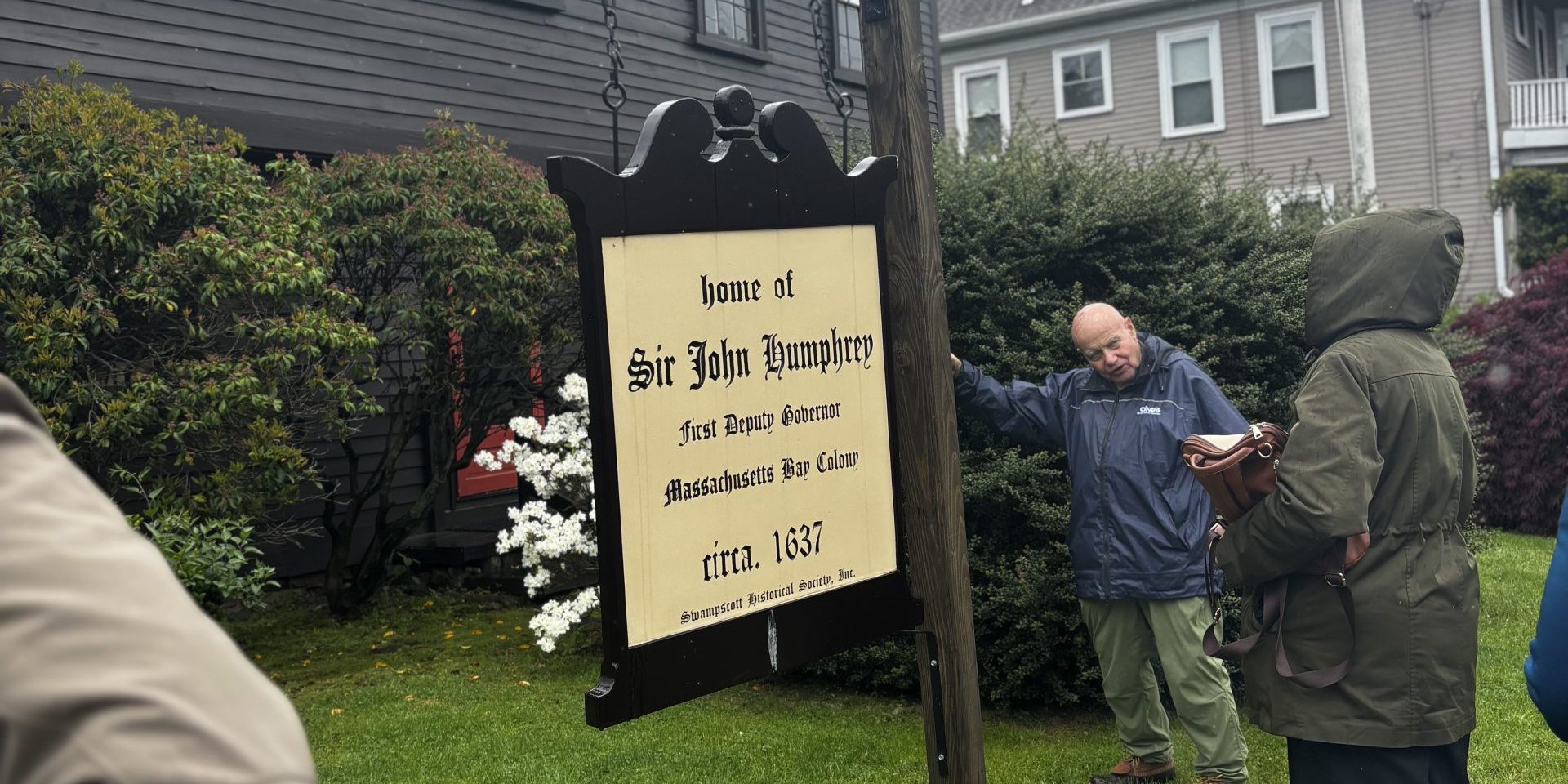
SWAMPSCOTT — The Historical Society opened the doors of the Sir John Humphrey House ahead of Memorial Day weekend, inviting visitors to explore one of the oldest and most storied homes in the country through a morning of public tours.
Leading the tours were Historical Society President Molly Conner and twin brothers Douglas and Duncan Maitland, whose walk-through blended architectural history, local folklore, and decades of research into both the house and Swampscott’s past.
The house, now located along Paradise Road, originally stood on Elmwood Road and is believed to date back to 1637. Historical records tie the house to Sir John Humphrey, an English Puritan who served as the first Deputy Governor of the Massachusetts Bay Colony, though Conner acknowledged that much about the building remains unconfirmed.
“We hope it’s the John Humphrey House, but we don’t actually know for sure,” Conner told visitors. She explained that definitively dating the structure would likely require dendrochronology testing, a scientific process that studies tree rings in old wood to determine when timber was cut and used in construction.
Conner said those tests could also help answer long-standing questions about when additions were built onto the home and how the structure evolved over time.
That uncertainty, though, is part of the appeal.
Nearly every room in the house comes with its own mystery. In one preserved second-floor room, which now serves as a museum space filled with local artifacts, guides pointed out unusual painted boards, well preserved in the room thanks in part to old sailcloth coverings that once protected the walls from winter drafts. Some of the markings are believed to have Native American influence, though Historical Society members stressed they are still hoping to find experts who can properly authenticate them.
“Have you ever seen anything like this?” Duncan Maitland asked visitors while gesturing toward the faded designs on the beams. “Never, never, never.”
In that same room, Conner encouraged guests to search for centuries-old “witch marks” carved into wood near fireplaces, windows, and doors. The symbols — including daisy wheels and web-like carvings — were once believed to protect homes from evil spirits or bad luck.
“They’re really hard to see,” Conner said while showing visitors how to angle a flashlight against the woodwork. “It’s like a treasure hunt.”
The house itself still feels remarkably authentic, particularly on the top two floors. Duncan Maitland pointed out massive “king’s boards,” unusually wide planks cut in a time when all large timber technically belonged to the British monarch. Hand-cut wooden pegs remain visible throughout the framing of the house, where builders used them in place of expensive metal nails.
Narrow staircases with uneven steps connect the upper floors in the back of the house, and visitors were warned to hold tightly to the railing while climbing down the cramped passage. At one point, Duncan Maitland jokingly referred to the top step of that back staircase — nearly twice the depth as the others — as the “killer step.”
On the third floor, Maitland pointed out original whitewashing still visible on the attic walls, evidence, he said, that the upper level was actively lived in centuries ago. Another museum-esque display featured antique children’s furniture and an old, wooden salt box — the same sloped design that gave the home its “saltbox” architectural style.
The tours also moved beyond the house itself into broader pieces of Swampscott history. Guides discussed Native American communities that lived seasonally along the coastline, Swampscott’s fishing industry, the town’s once-grand summer hotels, and early local aviation experiments, including a Swampscott inventor inspired by seagulls flying over the ocean who later developed an early monoplane design briefly used by the United States Army.
Tours concluded in the property’s boathouse, where Ed Chaisson — whose family has deep ties to Swampscott’s fishing history — showed visitors a replica Swampscott dory and discussed the evolution of local lobster fishing.
Guides explained that lobsters were once considered such low-quality food that they were commonly fed to prisoners before becoming one of New England’s defining seafood staples. Visitors also learned about the invention of the lobster pot trap in Swampscott and the role local fishermen played in shaping the town’s maritime identity.
By the end of the tour, visitors had moved through centuries of Swampscott history — from colonial architecture and maritime traditions to local stories told in the beams and walls of the house itself.
24World Media does not take any responsibility of the information you see on this page. The content this page contains is from independent third-party content provider. If you have any concerns regarding the content, please free to write us here: contact@24worldmedia.com
SWAMPSCOTT — The Historical Society opened the doors of the Sir John Humphrey House ahead of Memorial...

To the editor: “Take good care of the children.” Those were the last words Isaac Davis spoke to his...

SAUGUS — Residents lined Winter Street by Veterans Park as the annual Memorial Day parade marched by,...
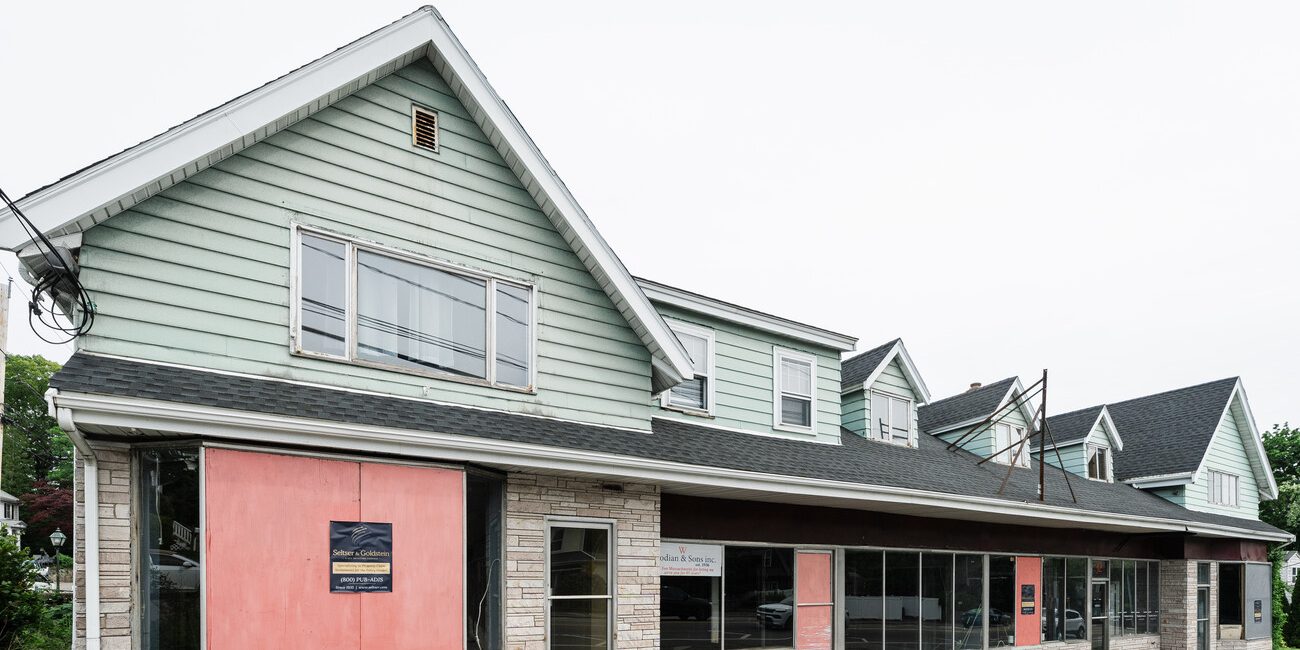
LYNN — A long-vacant building at the gateway to Lynn may soon be transformed into a new residential...
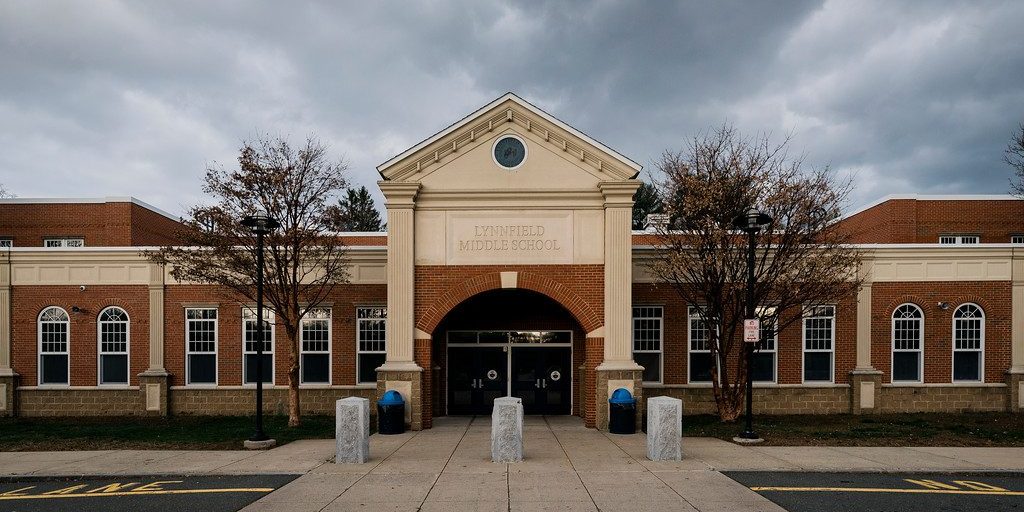
LYNNFIELD — During public comment, the Lynnfield School Committee was again met by multiple people,...

LYNNFIELD — Lynnfield Public Schools is proud to announce its 2026-2031 Strategic Plan: a...

St. Mary’s cruises by Lynn Classical in Mullins final

Weekend roundup: Softball Spartans conquer in style

New faces for Peabody girls soccer, field hockey
Kids in Community Summer Camp is coming to Lynn

Northeastern Conference championship meet action-packed

Roundup: Highlights aplenty in Mullins tournament

Marblehead students plant 1,800 poppies to honor veterans ahead of Memorial Day

Today’s Page 1: May 23, 2026

Lynnfield house catches fire. Again.

Better Beaches Program brings $47K to Lynn

Saugus resident arrested for voting illegally
City of Lynn Public Health tick advisory