

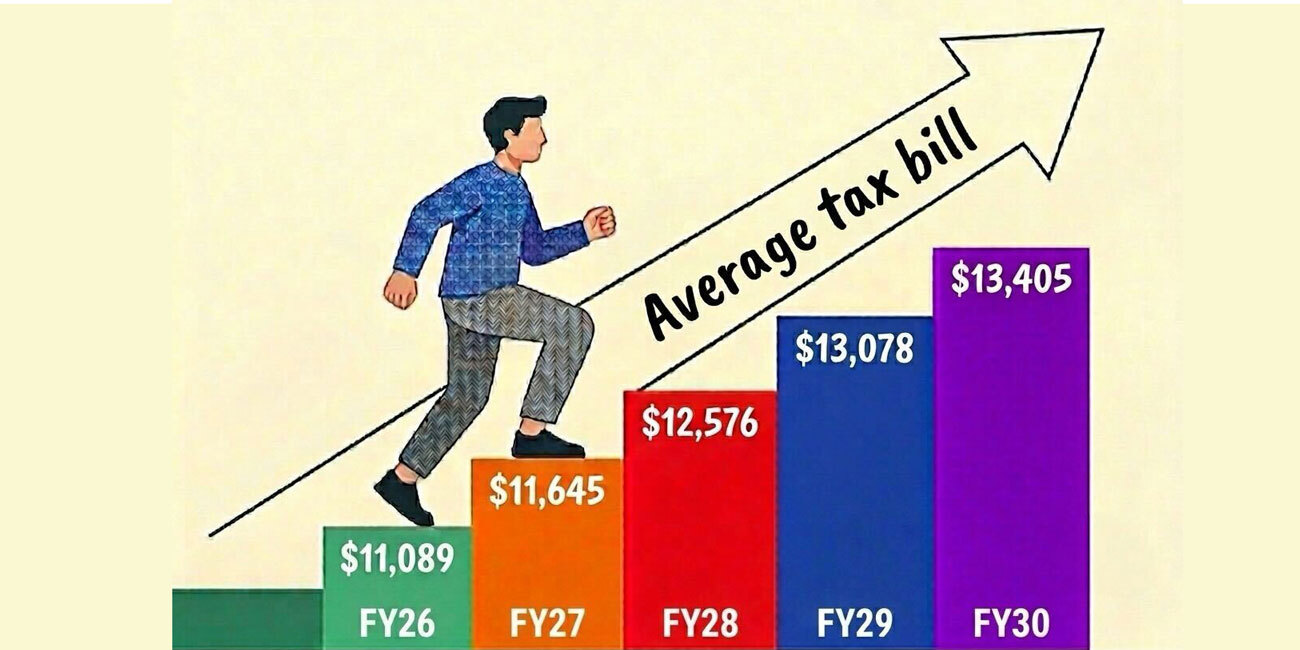
MARBLEHEAD — Depending on who is doing the math, Marblehead’s proposed override could either cost the average homeowner about $1,989 annually, more than $8,000 over three years, or contribute to a 34% increase in the town’s overall tax levy.
Those vastly different figures, presented by four different sources, have become a point of confusion in the weeks leading up to the June 9 election.
Yet, a review of calculations published by town officials, the advocacy group For Marblehead, the opposition group Better Way, and Board of Health member Tom McMahon shows the numbers are often measuring different things.
The organizations are answering different questions while often speaking as though they are answering the same one. That is why voters are hearing dramatically different numbers.
At the center of the debate is a proposed three-tier override that would allow voters to approve up to an estimated $15 million in additional revenue, along with a separate $2.3 million override to fund the town’s new automated trash collection system.
While all sides are discussing the same ballot questions, they are using different methods to calculate the impact.
Town officials and the pro-override group For Marblehead have largely focused on the estimated annual increase to individual homeowners based on assessed property values.
According to the town’s override presentation, a home assessed at Marblehead’s average value of $1,291,507 would eventually see an estimated annual property tax increase of approximately $1,989 under the $15 million Tier 3 override once the proposal is fully phased in over three years. For a home assessed at the townwide median value of $998,600, the ultimate estimated annual increase would be approximately $1,538.
The town breaks that increase into three phases. For the average assessed home under Tier 3, officials estimate an increase of approximately $556 in the first year, $931 in the second year, and $502 in the third year, resulting in a total annual increase of approximately $1,989 once the override is fully implemented.
Town officials have repeatedly emphasized that the override would not be implemented fully in year one and that the tax impact would grow gradually as positions and programs are restored. The override would be implemented over three years rather than all at once, an approach the Select Board and School Committee said is intended to reduce the immediate impact on taxpayers.
A memorandum of understanding (MOU) outlines how the town and Marblehead Public Schools intend to guide how new revenue from the potential overrides would be managed over the next three years. The agreement is not legally binding.
Under the MOU, future revenue is expected to be split roughly 62% for schools and 38% for town services, based on current cost structures.
The agreement also includes a commitment to not entertain another override request until at least 2030, along with provisions for annual financial reviews between town and school officials.
Finance Director Aleesha Benjamin said the town’s calculations are based on the phased implementation plan approved by Town Meeting.
“In Year 1, only the initial amount necessary to fund the approved FY27 budget is added to the tax levy. In Year 2, the Year 1 amount grows by the allowable 2.5% annual levy increase, and an additional amount is added to address the Year 2 FY28 phase of budget needs. In Year 3, the cumulative override amount from Years 1 and 2 grows by 2.5%, and the final phase of override funding is added for FY29, which will continue to increase at 2.5% annually in perpetuity,” Benjamin said.
She said the phased approach allows the town to match tax revenue increases with actual budget needs while reducing the immediate impact on taxpayers.
Town Administrator Thatcher Kezer said the town’s figures focus on what residents would pay under the financial plan currently before voters.
“The Town believes the most meaningful information for voters is the estimated annual tax impact associated with the financial plan currently before them,” Kezer said.
Kezer said some public discussion has blurred the distinction between a community’s levy limit and the amount it actually raises in taxes each year.
“The actual taxes raised in any given year depend on how much of that authority is utilized through the annual budget process. The Massachusetts Department of Revenue is very clear on this distinction: the levy limit is the maximum amount a community is authorized to raise, while the levy is the amount actually raised,” he said.
While the proposed override would increase the town’s levy limit, Kezer said the financial plan approved by Town Meeting does not call for using all of that authority immediately.
“Instead, the plan phases in the use of that levy capacity over multiple years. Therefore, the actual tax impact in any given year is based on the amount of levy authority utilized to support that year’s budget, not the full amount of taxing authority authorized by the override,” he said.
Kezer said Better Way’s cumulative calculations are “not incorrect as a mathematical exercise,” but argued that annual tax impacts tied to the financial plan before voters provide a more useful measure for residents evaluating the proposal.
“Any homeowner can add together multiple years of tax payments and arrive at a cumulative total. However, cumulative projections necessarily rely on assumptions about future budgets, future Town Meeting appropriations, and future tax decisions that have not yet been made,” he said.
The town’s calculator is available at: https://marbleheadma.gov/override/
For Marblehead has largely adopted the town’s accounting in its public outreach, directing residents to tax calculators that are based on assessed values and emphasizing the override’s phased implementation.
The group has also challenged claims by Better Way about how much Marblehead taxes have increased in recent years.
In a statement to the Marblehead Weekly News, For Marblehead disputed statements circulating on Facebook that average single-family tax bills increased approximately 46% between 2020 and 2026.
Instead, the organization cited Massachusetts Department of Revenue data showing Marblehead’s residential levy increased from approximately $66.3 million in fiscal 2020 to roughly $80.9 million in fiscal 2026, an increase of about 21.5%.
That disagreement highlights another distinction in the debate. The residential levy measures the total amount of residential property taxes collected townwide, while the average tax bill measures what an individual homeowner pays. Because assessments and property values change over time, the two figures do not necessarily increase at the same rate.
Co-chair of For Marblehead, Matt Hooks, said, “While the ‘forever’ cost of an override may seem high, we are paying for the ‘forever’ value of living in Marblehead.”
He added, “Taxes are a payment for services, not a one-time purchase. Firefighters, police officers, DPW workers, teachers, regular maintenance – these are not one-time costs. They are the people and services that Marbleheaders enjoy and benefit from every year.”
Hooks said, “We don’t think about other expenses – electric bills, water bills, cell phone bills – on a cumulative basis. They are recurring services with recurring costs, which is generally how prices are communicated.”
For Marblehead’s calculator is available at: https://www.formarblehead.org/calculator
Better Way Marblehead, which opposes the override, uses a different approach. The organization argues that annual tax estimates only tell part of the story.
On its website, the group publishes a chart titled “Year by year: what you actually pay,” which combines the proposed Tier 3 override, the trash override, and annual Proposition 2½ growth.
For an average Marblehead home assessed at $1.29 million, the town estimates the largest override would increase annual property taxes by approximately $1,989 once fully phased in. Better Way’s calculation, by contrast, focuses on the cumulative taxes paid during fiscal years 2029 through 2031, producing a three-year total of $8,195.
Put another way, the town is measuring what the override adds to a homeowner’s annual tax bill once fully implemented, while Better Way is measuring what that homeowner would pay during the three years after the override has taken effect and future Proposition 2½ increases have been applied.
For a home assessed at Marblehead’s median value of $998,600, the town estimates an annual increase of approximately $1,538 under Tier 3. Better Way‘s chart estimates a homeowner with a $1 million home would pay $6,346 in additional taxes over fiscal years 2029 through 2031.
John DiPiano, a spokesperson for Better Way, said some confusion stems from the fact that the group’s materials contain more than one calculation.
“The chart is what they could tax us. The calculator is what they will tax us,” DiPiano said.
According to DiPiano, Better Way‘s online calculator allows residents to enter their address, pull their assessed property value, and estimate the impact of various override scenarios.
Better Way’s calculator is available at: https://betterwaymarblehead.com/
He said the calculator was designed to reflect what homeowners would pay under the town’s phased implementation plan, while the chart reflects the town’s broader taxing authority under the proposed levy increase. Also, on the organization’s signs, the figure is rounded down to $7,500 to err on the conservative side.
“To make an informed vote, go to Better Way Marblehead’s Website and use the calculator to see what the override will cost you,” he said.
DiPiano said Better Way believes voters should consider the long-term effect of permanently increasing the town’s levy limit and the future Proposition 2½ increases that would be calculated from that higher base.
“These overrides are permanent. They are forever,” DiPiano said.
Better Way has a petition available to sign at the Three Cod Tavern for a Special Town Meeting if the override fails.
The organization has stated that the Percy family, which owns the Three Cod Tavern, feels strongly about citizens’ rights to petition and are long-time Marblehead residents who care deeply about the town.
There will not be a need for the Special Town Meeting in the event that the override passes.
A third set of figures has been circulated by McMahon, a Board of Health member who has publicly stated he has no bias regarding the override, either way, and has a background in data analysis.
Instead, McMahon’s spreadsheet examines growth in the town’s total tax levy. Unlike the town, For Marblehead and Better Way, McMahon’s analysis is not designed to estimate what a specific homeowner will pay.
Starting with an estimated $77 million tax base, McMahon added the proposed override amounts, the trash override, annual Proposition 2½ increases, and debt exclusions.
His calculations show the town’s total levy growing by approximately 13.2% over three years, with only the trash override, 25.5% under Tier 1 plus trash, 29.6% under Tier 2 plus trash, and 33.7% under Tier 3 plus trash.
McMahon said he included annual Proposition 2½ increases and recently issued debt because he believed omitting those figures would provide an incomplete picture of future tax obligations.
“If you want to know … this is how much your taxes will be, you have to include the debt that we just issued, because it’s not currently in the tax base, and you have to include the Prop. 2½ components per year,” he said.
Those projected percentages do not represent increases to individual homeowners’ tax bills. Rather, they represent growth in the town’s overall taxing authority.
Concerning the levy, which is expected to reach $15.8 in three years, with the 2.5% escalator every year, further complicates the math. What the house next door just sold for is what yours will be assessed at within the next three years, since the assessor attempts to re-assess one-third of properties each year. McMahon said his methodology provides an overall percentage growth, which gives a more constant growth estimate.
One question raised by McMahon’s analysis is how voters should translate levy growth into household tax impacts. While the town and Better Way both provide homeowner-specific estimates, McMahon’s figures focus on the overall tax base available to the town.
McMahon said his goal was not to advocate for or against the override but to provide residents with another way to evaluate the proposal.
“I’m not telling you to vote yes or no,” he said. ” But you have to have accurate information when you vote.”
Viewed side by side, the figures appear dramatically different. Yet each calculation is attempting to answer a different question.
The town estimates what the override would add to a homeowner’s annual tax bill based on a three-year phase-in, but without accounting for tax base percentage increases.
For Marblehead has largely adopted that methodology while arguing that recurring municipal services should be evaluated as annual costs rather than cumulative expenses.
Better Way estimates what homeowners could pay over multiple years after the override is fully implemented and future Proposition 2½ increases are applied.
McMahon’s analysis examines growth in the town’s overall taxing authority rather than individual tax bills.
As a result, voters are often comparing numbers that appear contradictory, even though they are measuring different aspects of the same proposal.
As June 9 approaches, the override debate has increasingly become not only a discussion about tax increases, but also a discussion about how those increases should be measured.
24World Media does not take any responsibility of the information you see on this page. The content this page contains is from independent third-party content provider. If you have any concerns regarding the content, please free to write us here: contact@24worldmedia.com

Alison Omens was looking for a way to root herself more deeply in Greenport when the North Fork Arts...

The final green of a grueling 100-hole fundraiser for ALS is not like any other. By then, the golfers...

LYNN — A man in Lynn was stabbed near 100 Willow St. on Saturday. According to the Lynn Police...

SAUGUS — Prince Pizzeria has officially been leaning on Route 1 for 65 years Monday, becoming a staple...

SAUGUS — For some people, once they set their sights on accomplishing something, that’s it —...

The post Today’s page 1: 6-2-26 appeared first on Itemlive. Source...

Fifth graders find their strides at Manning Field

Nahant to vote on override on June 24

LTTE: Seniors deserve to age at home

Commentary: Gen Z begs legislators: Make social media social again
Competing override findings cause confusion in Marblehead

Swampscott senior knitting club takes it one stitch at a time

Lynnfield continues its roll – Itemlive

Regional library funding concerns reach Swampscott

State tournament roundup: Spartans march on

Peabody Schools play it Safe
Police Logs: May 31, 2026
Commentary: How AI is already improving lives